
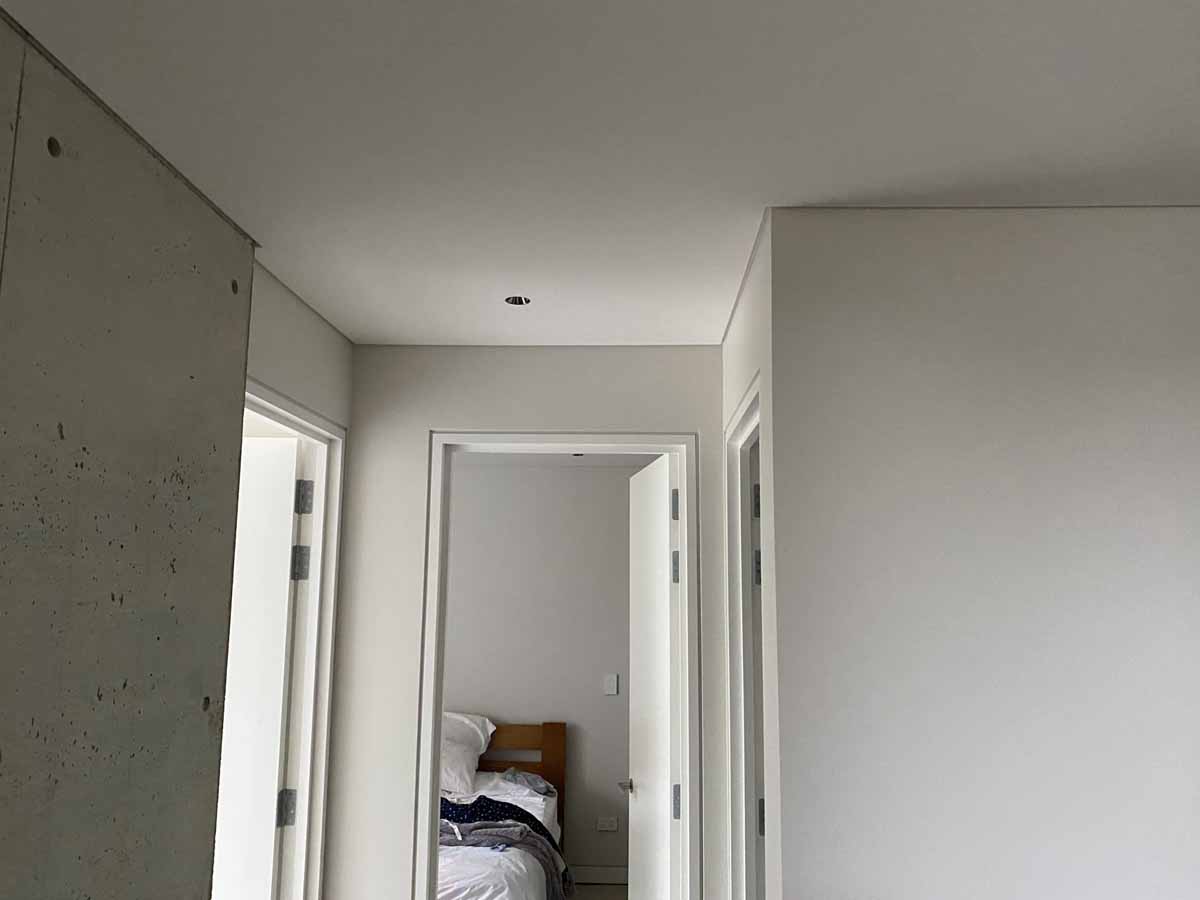
If you have been quoted for GIB® stopping or a new interior fit-out, you may have seen the terms Level 4 and Level 5 finish. They can sound like different grades of workmanship, but that is not quite what they mean.
The right level depends heavily on what happens after the plasterboard is stopped. Paint sheen, colour and lighting all affect how much of the underlying surface you will see. A wall that looks perfectly good with a light low-sheen colour can behave very differently once it is painted charcoal beside a large window.
We see this regularly in Auckland homes. Getting the finish level right before painting starts is far easier than trying to correct visible joints and surface differences afterwards.
What Is a Level 4 GIB® Finish?
Level 4 is the standard finish used for many plasterboard interiors. It involves properly taped and stopped joints, multiple coats of jointing compound and a smooth surface prepared for decoration.
For normal residential conditions, Level 4 works well with flat, matt and low-sheen paint where the room does not have difficult lighting. It is not a lower-quality shortcut. It is simply a finish designed for a particular set of conditions.
Our GIB® fixing Auckland work is important here because finish quality begins before stopping. Sheet layout, framing alignment, fixing and joint positioning all influence how easily the final surface can be finished cleanly.
Under harsh or critical lighting, however, small surface differences can still become visible with Level 4.
What Makes a Level 5 Finish Different?
Level 5 starts with the requirements of Level 4, then adds tighter preparation and an additional skim treatment across the full plasterboard surface.
One of the biggest differences is that the skim coat is applied across the whole defined area rather than only across joints and fastener points. This helps reduce differences in texture and porosity between the plasterboard paper and stopped joints.
That distinction matters once paint is applied.
A Level 5 finish is commonly specified where:
- gloss or semi-gloss paint will be used
- dark paint colours are planned
- strong side lighting falls across the surface
- large windows create critical light
- the client wants a particularly consistent painted finish
Level 5 is also more demanding during installation. Current GIB® guidance requires tighter framing tolerances and additional back-blocking requirements, so this decision should ideally be made before the boards are installed rather than once the painter arrives.
Critical Light Is Where Finish Quality Becomes Obvious
Critical lighting is one of the main reasons we discuss Level 5 with clients.
It occurs when light strikes a wall or ceiling at a shallow angle instead of falling directly onto it. Large windows beside long walls, skylights, wall lights and lighting that washes across a ceiling can all create this effect.
The light casts tiny shadows across ridges, joint build-up and differences in texture. A surface that looks smooth under normal room lighting can suddenly show every transition.
This is particularly relevant in modern Auckland homes where larger windows, open-plan living spaces and architectural lighting are common.
If your design creates strong critical light, it is worth discussing the required finish before our plastering Auckland work begins.
Why Dark Colours Can Reveal More
Dark paint looks impressive, but it can be less forgiving.
Deep greens, blues, greys and near-black finishes can make slight changes in texture easier to see, especially when natural light moves across the room during the day. The issue is often not the paint itself. It is the way the colour and light interact with the substrate.
This does not mean every dark wall automatically requires Level 5. The room, lighting, wall position and paint sheen all need to be considered together.
For a dark feature wall sitting opposite a window, however, I would rather discuss the surface requirements before stopping than wait until the final coat exposes something the homeowner was not expecting.
Gloss and Semi-Gloss Need Extra Care
Paint sheen also changes how forgiving a wall is.
Flat and low-sheen finishes scatter light, which tends to soften small surface variations. Gloss and semi-gloss reflect it much more directly. That reflection can emphasise stopping lines, sanding marks and texture differences.
Current GIB® guidance recommends Level 5 where gloss or semi-gloss finishes are specified.
This is one reason our house painting Auckland team and stoppers need to understand the final specification early. The stopper needs to know what the painter will eventually put over the wall.
Level 5 Does Not Mean a Perfectly Flat Wall
This is an important point because Level 5 is sometimes sold as a completely flawless or perfectly flat surface.
That is not technically correct.
Plasterboard surfaces can still have minor physical variations. The purpose of the Level 5 skim coat is primarily to create greater consistency in surface texture and porosity between the paper face and the stopped areas. Even a well executed Level 5 surface can show minor imperfections under particularly harsh critical light.
The goal is to minimise visible variation, not promise that light can never expose anything.
Level 4 or Level 5: Which Does Your Auckland Home Need?
For many bedrooms, hallways and ordinary living areas with light colours and low-sheen paint, Level 4 is usually appropriate.
Level 5 becomes worth discussing when several demanding conditions come together, such as:
Large windows beside long walls
Strong natural light can travel almost parallel with the surface and highlight joints.
Dark colours
Dark tones tend to make small texture differences easier to see.
Gloss or semi-gloss paint
Reflective paint makes the quality of the substrate particularly important.
Feature lighting
Wall washers, downlights positioned close to walls and some ceiling designs can create difficult viewing conditions.
The finish should be selected around the actual room, not simply because Level 5 sounds like the higher number.
Plan the Finish Before the Paint Goes On
The easiest way to get the result you expect is to decide the finish level early.
Our blog on how to achieve seamless walls with professional GIB® stopping in Auckland explains how joint work, sanding and surface inspection all contribute to the finished wall.
If you are planning dark colours, gloss paint or a room with strong critical light, talk to us before the GIB® work starts. We can assess the design, discuss the finish you are trying to achieve and make sure the fixing, stopping and painting stages are working towards the same result.

